ScreenshotInternalTraining_BarryHardy2

Internal Training on SSbD (28.05.2025)

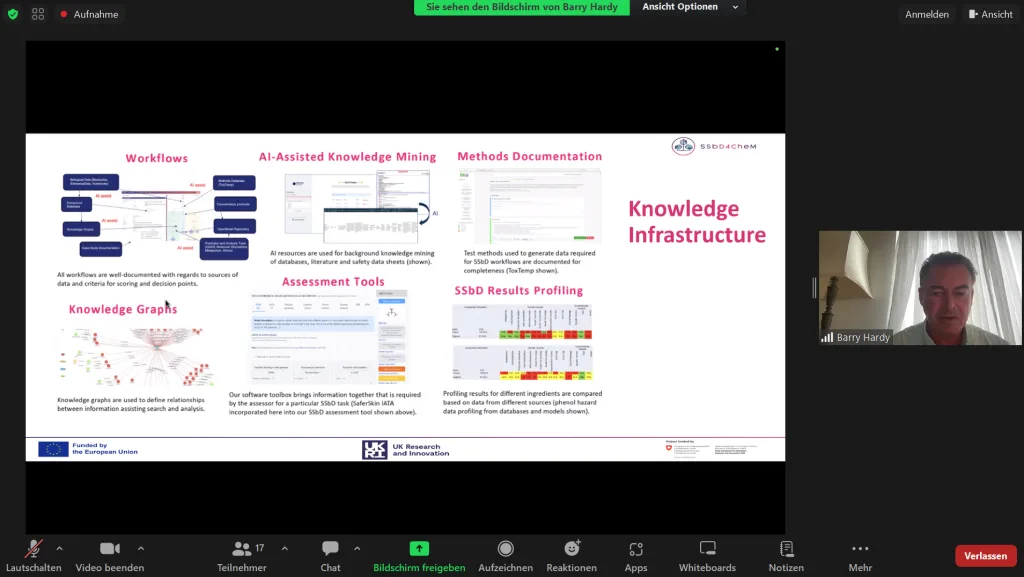
On 28 May 2025, an internal online workshop was held under the SSbD4CheM project for a duration of two hours. The session was organized by the Edelweiss Connect (EwC) team and attended by members of the entire consortium. The aim of the workshop was to provide an overview and hands-on demonstration of the SSbD tools implemented within the SSbD4CheM Knowledge Sharing Portal, supporting safer and sustainable by design (SSbD) assessments.

Detailed program:

The first part introduced the SSbD framework and presented how the newly developed tools can support the first step of the assessment process by increasing automation and simplifying user interaction.

The second part focused on AI-assisted resources designed to facilitate knowledge discovery and extraction. One highlighted tool was the SDS Toolbox, which enables users to search for Safety Data Sheets (SDS) online using a CAS number or IUPAC name, and to automatically parse and extract structured data from SDS PDF files. This toolbox integrates an end-to-end pipeline combining the search (SDS-FIND) and extraction (SDS-STRUCT) components into a single seamless process [DOI: 10.5281/zenodo.16735362]. 

Another tool introduced during the workshop was PubChemPal, developed to facilitate efficient access, retrieval, and management of chemical data from PubChem for SSbD applications. PubMed ChemInsight is an intuitive web-based tool designed to help researchers efficiently retrieve and analyze scientific literature related to specific compounds and their interactions [DOI: 10.5281/zenodo.14771565]. 

Several notebooks were also integrated into the portal to support the project such as the dataset for CLP classification, ecotoxicological endpoints, as well as chemical similarity search on repeated dose toxicity studies, and repeated dose toxicity studies.

The next part introduced SmartSafety, an operational safety assessment and decision-support tool designed to manage and evaluate product safety through a centralized repository of ingredient and formulation data. The system can interoperate with other platforms to enhance the performance of human health assessments such as Margin of Safety (MOS) and Quantitative Risk Assessment (QRA) calculations as well as to estimate environmental impact indicators. A new module has been incorporated to specifically support SSbD-related evaluations.

NAMs Test Method Documentation was also addressed, which provides a template and database for the systematic documentation of in vitro methods. This resource enables linking test methods to their respective readiness levels and incorporates a review workflow to ensure quality and traceability.

The following sections addressed the Physical–Chemical Characterisation Workflow and the use of workflow software for documenting SSbD steps. The Physical–Chemical Characterisation Workflow presented the process for organizing and managing protocols and associated datasets. This workflow supports the generation of harmonized and traceable data, ensuring consistency across different stages of assessment and facilitating integration with other SSbD components.

Subsequently, the use of workflow documentation tools was demonstrated to illustrate the SSbD process through the ASPA-supported NGRA workflow. The extension of this workflow to SSbD enables a step-by-step visualization of the entire assessment, guiding users through each phase and ensuring the required documentation is linked to the corresponding decision points. This structured approach enhances transparency, reproducibility, and communication of the assessment outcomes within the SSbD framework.

Workshop materials:
  • The slides will be available soon
  • The recording will be available soon
ScreenshotInternalTraining_BarryHardy

Read More
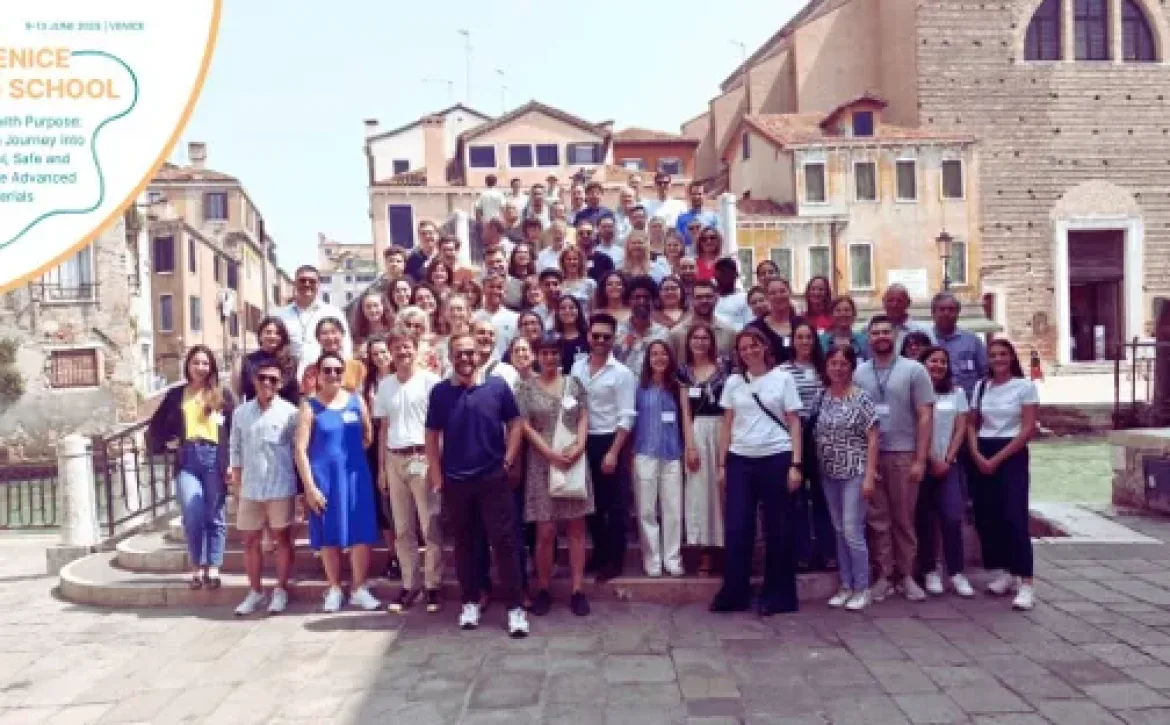
GroupPic_VeniceTraining School2025

Recap Venice Training School 2025

The Safe-and-Sustainable-by-Design (SSbD) concept starts at the very earliest stages of the design process – so why not plant the seeds early with the researchers and consumers of the future?

Read More
IMG-20250616-WA0019

Internal Training on Pyrolysis-GCMS and Analytical Methodologies at VITO

From 11-15 May 2025 took place the SETAC 2025, the 35th Annual Meeting of the Society of Environmental Toxicology and Chemistry in Europe, at the Austria Center in Vienna.

Read More
photo5

Internal Training on ChemInformatics tools

On 21 May 2025, during the second day of our General Assembly in M17 in Valencia (Spain), the colleagues of NovaMechanics and Entelos (Panagiotis Kolokathis and Tassos Papadiamantis), gave an internal training to the whole consortium (approx. 25 participants) on the ChemoInformatics tools that they develop, to learn how to use them for data analysis and machine learning, run exposure scenarios, calculate atomistic desriptors, run already developed machine learning model and understanding their output (e.g. applicability domain).

During the session entitled “Investigation of Chemicals and Materials Safety through the Isalos, Enalos and Eos Cloud Platform tools and functionalities”, participants learned to use computational tools powered by the Enalos Cloud Platform, Eos Cloud Platform, and the functionalities/workflows of Isalos Analytics Platform, to predict the properties of a range of chemicals and materials for a range of case studies. Additionally, all partners discussed ideas about the applicability of these tools within the project.

Detailed program:
  1. Lung Deposition – A web application developed for analyzing particle deposition in human lungs and evaluating associated hazards based on the ICRP or the MPPD model.
  2. SimpleBox4Planet – This tool provides a user-friendly environment to access the SimpleBox, a multimedia mass balance model used to evaluate the fate of chemical substances in the environment. The tool includes a database with the properties of candidate substances used as PFAS alternatives.
  3. MicroPlasticFate – This web application simulates the fate and behaviour of nano- and microplastics (NMPs) aross multiple environmental scales, including regional, continental and global scale, each of which consists of compartments/media of air, soil, water and sediment.
  4. NanoXtract – Unique online tool for the calculation of 18 image descriptors based on Transmission Electron Microscopy (TEM) images of nanomaterials.
  5. UANanoDock – It is a web-based United Atom multiscale nano-docking tool for predicting protein adsorption onto nanoparticles at a selected pH (e.g., preferential protein orientation, adsorption energy, etc).
  6. Titania – Tool for the simultaneous property and toxicity prediction of sets of chemical compounds. Users can import compounds of interest by drawing molecules and inspect a 3D visualization of their molecular structures post-drawing.
  7. Nanotube Construct – Tool for the digital construction of energy minimized nanotubes of single layer materials and calculation of their atomic descriptors powered by the Enalos Cloud Platform.
  8. HydroNanoConstruct – Toolbox for the digital reconstruction of energy minimized metal-oxide nanoparticles, based on their CIF files and the calculation of their atomistic descriptors, in water.
  9. Sbd4Skin – SbD4Skin incorporates quantitative structure-property relationship (QSPR) models for skin toxicity endpoints prediction (acute dermal toxicity, skin irritation potential, and skin sensitization potential).
  10. Isalos Analytics Platform (Reference link 1 and Reference link 2) – The so-called Isalos, is a simple and user-friendly software designed to facilitate data manipulation and model development without requiring programming skills. This platform empowers non-programmers to engage in data analytics through an intuitive interface, which leverages commonly used computer functions such as menus, buttons, and spreadsheets.
Takis during the internal training

Read More
SaferWorldbyDesign_Workshop_202041106_Basel

SSbD4CheM @ Safe and Sustainable Product Design Workshop in Basel

Experts, researchers, and regulators came together for the Safe and Sustainable Product Design Workshop, hosted by SaferWorldbyDesign in Basel and online on 6th November 2024. The event, attended by around 50 participants (11 onsite and 40 online) from Swiss regulatory bodies, academia, and industry, focused on methods for embedding human safety, environmental protection, and sustainability in the early stages of product development.

The morning programme featured a series of lectures exploring state-of-the-art approaches and best practices, while the afternoon offered hands-on workshops where participants interacted directly with tools and data relevant to product safety and sustainability.

The SSbD4CheM project had a prominent presence throughout the day. Barry Hardy (Edelweiss Connect (EwC)) opened the event and moderated all throught the day. Project Coordinator Milica Velimirovic (VITO) opened the lecture session with an overview of the project’s Safe and Sustainable by Design (SSbD) framework. She highlighted its “learning-by-doing” approach, aimed at integrating safety and sustainability from the outset of innovation.

Indre Piragyte-Langa Oliva (EwC) delivered a lecture on Hazard Characterisation using New Approach Methods (NAMs). She emphasized the role of NAMs in moving away from traditional, animal-based testing toward more ethical, data-driven, and predictive tools. Her talk showcased how SSbD frameworks, supported by NAMs and digital workflows, can help identify harmful chemicals early, speeding up regulatory processes while ensuring safer outcomes for both humans and the environment.

Thomas Arblaster (Leiden University) introduced participants to Life Cycle Assessment (LCA) as a quantitative method to evaluate environmental impacts throughout a product’s life cycle. His session explained how tiered LCA within the SSbD framework helps guide R&D by pinpointing key sustainability questions—even when data is limited.

In the afternoon, the workshop offered a deep dive into practical applications. Indre Piragyte-Langa Oliva (EwC) led participants through a case study on hazard characterisation for cosmetic ingredients, guiding them in using public databases and prediction tools to assess and score alternative compounds.

Barry Hardy (EwC) led participants in the examination of the properties of a formulation including selecting alternatives to ingredients for a substitution. Using EwC’s risk assessment software extended to SSbD, the group was able to score each ingredient in a formulation for environmental impact to narrow down options for best selections.

Thomas Arblaster (Leiden University) conducted a hands-on session on LCA using the openLCA tool, with a case study focused on plastic bottles. Participants learned to navigate databases, set up systems, and evaluate product sustainability using real-world scenarios.

The workshop not only provided valuable training but also underlined the importance of integrating advanced tools and data from the earliest stages of product design. By combining SSbD principles with innovative methods like NAMs and LCA, the event highlighted a path forward for creating safer, more sustainable chemicals and materials.

Lecture Program

Workshop

Barry Hardy presenting
Lecture of Indre Piragyte-Langa Oliva
Thomas Arblaster during his LCA introduction
General poster of SSbD4CheM during the wrkshop

Read More
20240812_131648

Internal Training & Knowledge Transfer Tofwerk – Wood k plus

The MaterialsWeek 2024 took place 17-21 June 2024 in sunny Limassol (Cyprus). The event aimed to bring together Research and Innovation (R&I) communities that are driving advances in materials innovation manifested across diverse value chains and industrial markets.

Read More