2ndNSCworkshopSSbDscenarios_Cover

Recap of the 2nd NSC workshop on “SSbD scenarios” on 5 December 2025

Following up from the 1st NSC workshop on “SSbD scenarios for advanced and incremental innovations” (23 June 2025), the NSC Working Group on Safe and Sustainable by Design (SSbD), Innovation & Regulation organised a virtual 2nd NSC workshop on SSbD Scenarios on 5th December 2025. Similarly as the first workshop, this second one was prepared as a collaborative effort among several EU-funded projects: DESIDERATA,  PLANETS, SSbD4CheM, and SUNRISE.

The 1st NSC scenarios workshop laid the basis by the description of a scenario by aspects of novelty, exposure, severity, (environmental) sustainability, (economic) scope and immediacy. Case studies enabled a refinement of the scenario description (Wohlleben et al. 2025). The concept of a scenario was integrated by JRC into the revised SSbD Framework, where it serves as a bridge between the SSbD scoping and a tailored safety and sustainability assessment (reproduced in lower figure). It was described as “a specific and real set of conditions (scoping analysis elements) that define the context in which the SSbD assessment is carried out.”(Garmendia Aguirre et al. 2025). 

This 2nd NSC scenarios workshop explored how to describe an SSbD scenario, the tailoring rules related, as well as how to select which tailored approach fits best a specific innovation case. Examples of real-world cases were provided by innovators from the projects DESIDERATA, PLANETS, SSbD4CheM, and SUNRISE. In breakout sessions moderated teams went through the respective cases to define the SSbD maturity, pull and push, expected commercial value, probability of success (technical and commercial) and ultimately the return on investment that additional SSbD would expect. Obtained results were compared to six proposedly archetypal SSbD scenarios. This business-focussed algorithm enables defining a tailored SSbD in a more straight-forward manner. Such an approach, based on specifications collected during scoping, could argue for more or less extensive SSbD assessment to be implemented for different innovation cases, providing arguments for innovators in their discussion with management. 
2ndNSCworkshopSSbDscenarios_Agenda

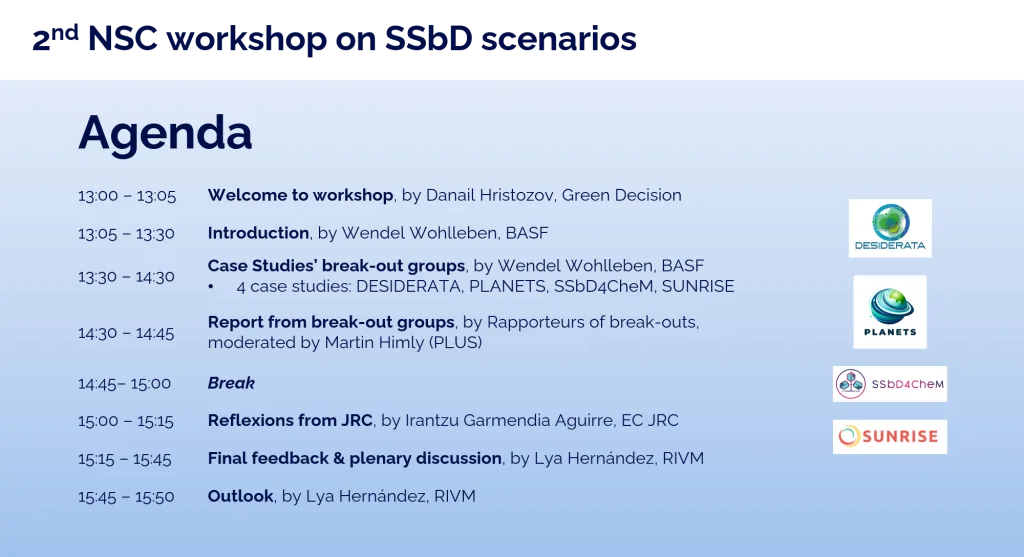
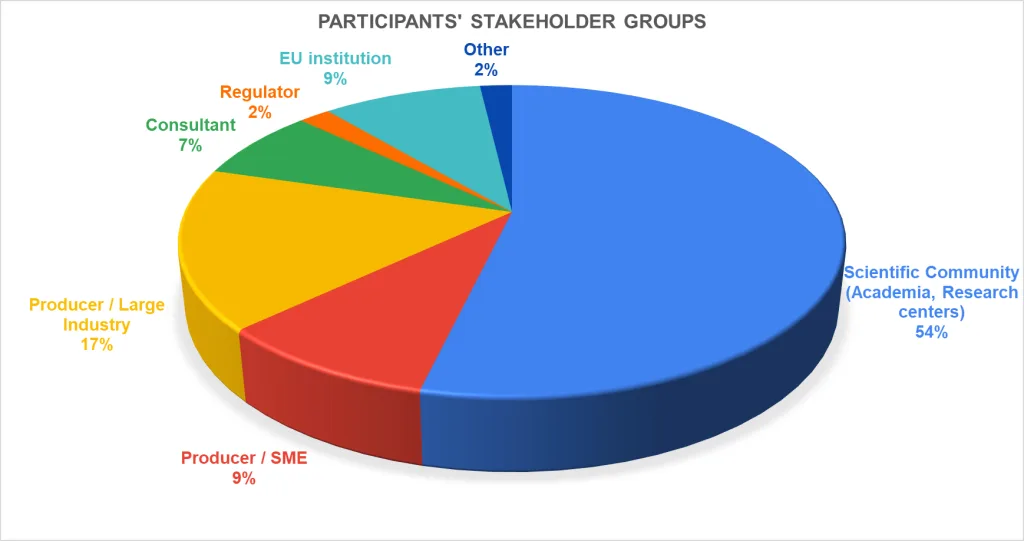
Danail Hristozov (GreenDecision, and chair of the NSC WG on SSbD) opened the workshop and welcomed the more than 50 international participants from academia (54%), large industry (17%), SME (9%), consultants (7%), regulators (2%) and EU institutions (9%). 
2ndNSCworkshopSSbDscenarios_StakeholderGroups
Overview of the participants’ stakeholder groups

Wendel Wohlleben (BAuA, formerly BASF, and co-chair of the NSC WG on SSbD) presented how to tailor the SSbD implementation by using the scenarios. He explained how the most relevant aspects describing the scenario were selected after the 1st workshop, and how the newly developed spreadsheet “SSbD-ified ECV calculator” estimates the impact of implementing SSbD into an innovation project plan. The standardised business metric of the “Expected Commercial Value (ECV)” was used as the basis for the tool, which had been made available to all workshop participants, and feedback was gathered during the break-out groups. 

Workshop participants split up into the break-out groups, where the tailoring and other aspects in the different innovation case were explored and discussed: 

  • DESIDERATA case study: Olga Thoda, from MONOLITHOS, on geopolymers originating from mining waste as replacement of Aluminum in construction, moderated by Lya Hernandez, RIVM.
  • PLANETS case study: Tobias Moss, from Budenheim, on flame retardants in construction, moderated by Carla Caldeira, SYENSQO.
  • SSbD4CheM case study: Ondej Panak, from the Slovenian National Institute of Chemistry, on cosmetics (assisted by Assaf Assis, David Barak, and Dror Cohen, from AHAVA Dead Sea Laboratories, moderated by Martin Himly, PLUS.
  • SUNRISE case study: María José López Tendero, from Laurentia Technologies, on post-harvest fruit treatment based on safer microencapsulated oil, moderated by Danail Hristozov, GreenDecision.

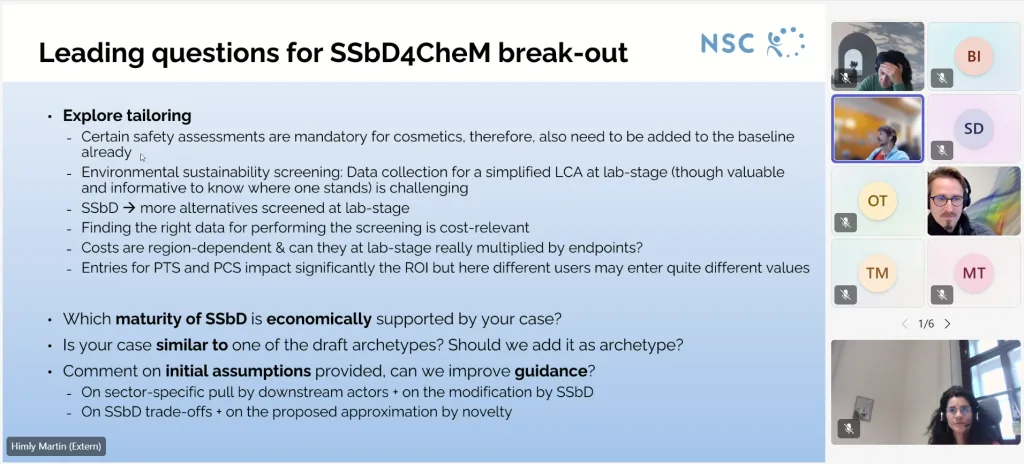
Martin Himly (PLUS and chair of the NSC WG on ETC) moderated the joint reporting session of the different breakouts, where the discussions in each of the groups were briefly summarised and discussed in the plenary. 

Irantzu Garmendia Aguirre from the European Commission’s Joint Research Centre (JRC) contributed key insights to the workshop, sharing the JRC’s perspectives on the current adaptations within the SSbD framework. Her intervention addressed the core SSbD principles, the scoping analysis, and the development of SSbD scenarios, highlighting their relevance for advancing safe and sustainable innovation.

The workshop ended with a final round of feedback and plenary discussion, moderated by Lya Hernández (RIVM), where workshop participants dived into vivid discussions, which will be picked up in the 3rd NSC scenarios workshop anticipated for late spring 2026.

Two main activities are planned as follow-ups of this 2nd workshop: A third workshop (planned for 2026) to discuss the process from archetypal scenarios to tiered SSbD assessment, and a joint peer-reviewed NSC publication about the tailored SSbD approaches followed by the different case studies presented in the workshop.

Workshop materials:

Workshop materials are publicly available in Zenodo, under DOI: 10.5281/zenodo.19554509

The recording of the workshop is available in the NSC YouTube channel.

References:
  • Garmendia Aguirre, I., E. Abbate, G. Bracalente, L. Mancini, G. Cappucci, D. Tosches, K. Rasmussen, B. Sokull-Klüttgen, H. Rauscher and S. Sala (2025). “Safe and Sustainable by Design Chemicals and Materials. Revised framework”. Draft for consultation, can be accessed here.
  • Wohlleben, W., C. Caldeira, M. Himly, L. G. Soeteman-Hernández, D. Hristozov and B. Serrano Alfaro (2025). Materials of the NSC workshop on “SSbD scenarios for advanced and incremental innovations” on 23 June 2025. Zenodo. DOI: 10.5281/zenodo.15756156.
  • European Commission SSbD Framework
 
Impressions of the workshop:
Screenshot_ReportBreakOuts
2ndNSCworkshopSSbDscenarios_Cover

Read More
ANTHOS26_GroupPic_cut

SSbD4CheM @ ANTHOS’26

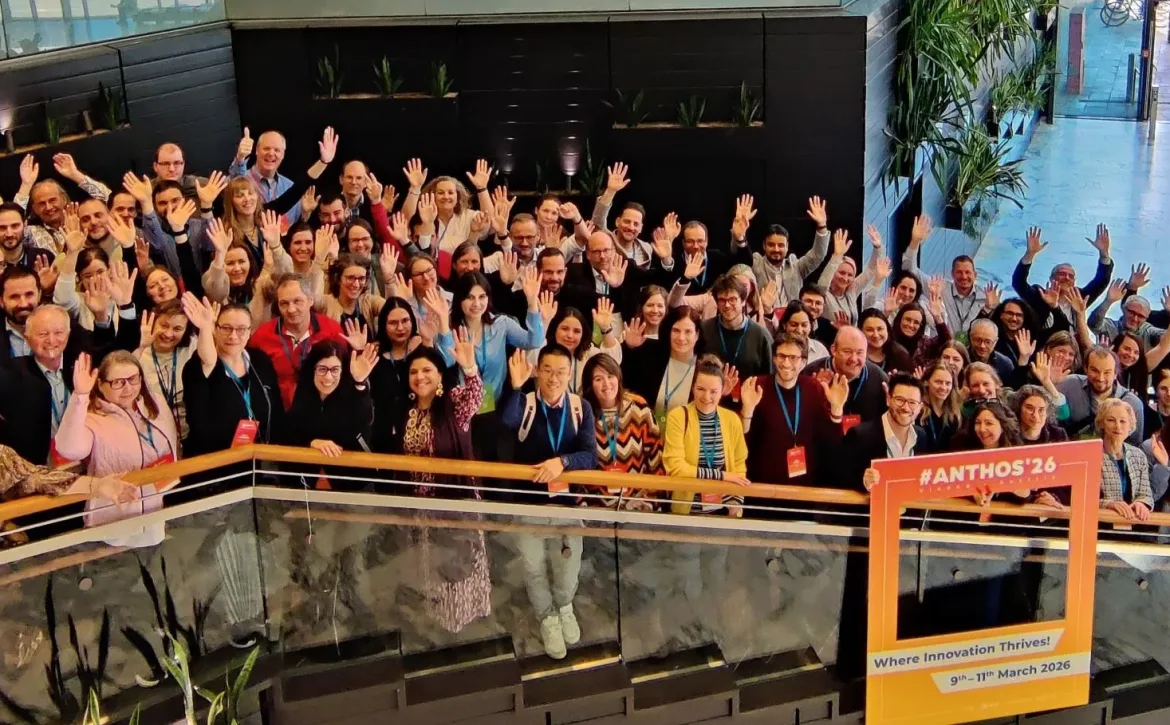
Held from 09-11 March 2026 in Vienna, ANTHOS’26 gathered over 120 experts to advance dialogue on Safe-and-Sustainable-by-Design (SSbD) for Advanced Materials (AdMa). Participants from academia, industry, policy, and regulatory bodies explored ways to align stakeholder needs (i.e., the initiators, the legislators, regulators and implementors) with the solutions that SSbD provides. Key discussions highlighted challenges such as data gaps, complexity, and limited SME uptake. EU-funded projects presented tools, AI approaches, and tiered assessments to support decisions at early-stages. A strong focus was placed on collaboration, regulatory readiness, and pragmatic tools, reinforcing SSbD as a driver for innovation, sustainability, and competitive advantage in Europe.
 
The event was organised by BNN, and supported by the NSC and 12 EU- and national-funded projects (AI-TranspWood, AlChemiSSts, ATIMA, BIOSAFIRE, CheMatSustain, InnoMatSyn, INTEGRANO, PINK, PLANETS, SSbD4CheM, SUNRISE, TOXBOX), as well as two Austrian Ministries (BMIMI and BMLUK).
 

Across three days, the summit created a collaborative platform to exchange knowledge and showcase tools, methodologies, and case studies; discussions highlighted key challenges for SSbD implementation, including limited awareness—particularly among SMEs—data gaps, methodological complexity, and unclear economic incentives. Stakeholders emphasized the need for pragmatic, user-friendly tools, improved data sharing, and stronger links between research, regulation, and industry.

Sessions and roundtables addressed the perspectives of initiators, legislators, regulators, and implementors. A recurring message was the importance of shifting from reactive compliance to proactive, design-led innovation. Solutions presented by EU projects demonstrated how digital tools, AI, tiered assessment strategies, and life-cycle thinking can support early-stage decision-making and reduce risks and costs.

The summit also underlined the importance of regulatory preparedness, trusted environments, and cross-sector collaboration. Concepts such as regulatory sandboxes, standardized data formats, and the role of SSbD ambassadors emerged as key enablers for wider adoption.

ANTHOS’26 concluded with a forward-looking discussion stressing the need for incentives, education, and coordinated action to scale SSbD. The event successfully strengthened collaboration across the community and set the stage for future innovation in safe and sustainable materials.

ANTHOS26_GroupPic_cut

SSbD4CheM had a very active role in the conference:

  • Several partners were involved in the Organising Committee (Andreas Falk, Beatriz Alfaro (BNN), Milica Velimirovic (VITO), Ivana Burzic (WOOD K plus)),
  • and in the Scientific Committee (Andreas Falk, Milica Velimirovic, Ivana Burzic).
  • Andreas Falk, Antje Biesemaier (LIST) and Barry Hardy (EwC) reviewed the poster abstracts.
  • BNN (Andreas Falk) was the main moderator of the conference. 
  • Andreas Falk was speaker and panellist in the Solutions Session 2 (Legislators) representing the NSC.
  • Milica Velimirovic was Co-chair of  the Solutions Session 4 (Scientific Implementators).
  • The project roll up was exposed all throught the conference in the projects area, next to the SSbD4CheM booth.
  • Oral presentations:
    • Milica presented the project in the BioNanoNet Networking event. DOI: 10.5281/zenodo.19550468.
    • Yvonne Kohl (Fraunhofer) supported Pamina Weber (LIST) to prepare presentation in Session 4 (scie. Implementors) – “Bridging in silico, in chemico, in vitro assessments for SSbD-driven advanced materials and chemicals innovation – where do we stand – what is next – what can we reach?“, presented by Ivana Burzic. DOI: 10.5281/zenodo.19628304.
    • Barry Hardy gave an oral presentation in the Solutions Session 3 (Regulators), about in silico methods and AI developments, presenting the goals of the project with regulatory acceptance. DOI: 105281.zenodo.19389773.
  • Posters:
    • Ondrej Panak (NIC) in collaboration with AHAVA had a poster on the cosmetic CS, entitled “SSbD Assisted Implementation of Nanocellulose Additives in Skin Care Products“. DOI: 10.5281/zenodo.19368571.
    • LIST/Fraunhofer (Antje Biesemeier, Yvonne Kohl) had a poster on CNC characterisation in vitro experiments, entitled “Multimodal characterization of the safety and sustainability of cellulose nanoparticles in 2D and 3D in vitro model“. DOI: 10.5281/zenodo.19368540.
    • Florian Meier (Postnova) had a poster on CNC characterization ,entitled “A multi-analytical approach for guiding the safe and sustainable use of cellulose nanomaterials“. DOI: 10.5281/zenodo.19367261.
    • KORTEKS (Onur Celen and Mine Turkay) had a poster on “Advancing Safe and Sustainable Textile Materials in the SSbD4CheM Project: Industrial Production of Virgin PET, Recycled PET (r -PET) and Bio-Based PLA Yarns“, that was presented by Ondrej. DOI: 10.5281/zenodo.19470863.
  • Additionally Florian, Ondrej presented their posters in the Poster Pitch Session
  • The project also had a booth, sponsored by WOOD K plus, were we were able to showcase different prototypes developed in the frame of SSbD4CheM project – Visitors were super interested:
    • Automotive interior parts manufactured using novel Wood Plastic Composites (WPCs) with optimised emissions and odor (Wood K plus).
    • PFAS free water repellent and antimicrobial coated textile (Wood K plus, Novex, and KORTEKS).
    • High-sensitivity light scattering detector for cellulose nanomaterials’ characterization (Postnova).
    • Nanocellulose as sustainable additive being applied in different AHAVA cosmetic products (SPF lotions, facial creams, facial mud mask) serving for different functionalities (AHAVA, NIC).
Read a full recap of the three impactful days here.
 
Some insight into the 3 days – Have a look at the pictures!

Read More
SSbD4CheM_OverviewPlatform

The SSbD4CheM Knowledge Sharing Platform: Turning Safe and Sustainable by Design into Practice

The transition to safer and more sustainable chemicals and materials requires more than good intentions — it needs accessible knowledge, practical tools, and shared understanding across disciplines. This is exactly the main aim of the EU-funded project SSbD4CheM project. The project is developing the SSbD4CheM Knowledge Sharing Platform, a centralized, web-based infrastructure that offers tools, data, guidance, and training to support the implementation of the SSbD framework for chemicals and AdMa, as elaborated by the EC Joint Research Centre (JRC), and help stakeholders (researchers, industry, policymakers, etc.) translate the SSbD principles into real-world decision-making throughout their innovation processes.

Overview of the SSbD4CheM Knowledge Sharing Platform

The platform brings together a wide range of tools, data resources, methodologies, and guidance materials relevant to SSbD. Instead of navigating multiple disconnected sources, users can access structured information that supports safety and sustainability considerations from the earliest design stages through to assessment and evaluation. One of the platform’s key functions is to enable structured SSbD assessment workflows. Users can explore digital tools that support hazard screening, sustainability evaluation, and life-cycle thinking, helping them document and compare design choices in a transparent and reproducible way.

Beyond tools and data, the Knowledge Sharing Platform also serves as a learning environment. It provides access to training materials, guidance documents, and explanatory resources that help users understand SSbD concepts, methodologies, and regulatory contexts — supporting capacity building across sectors and disciplines.

In line with EU best practices, the platform promotes FAIR principles (Findable, Accessible, Interoperable, Reusable), ensuring that data and resources hosted or linked through the platform can be more easily discovered, reused, and integrated into other tools, projects, and innovation processes.

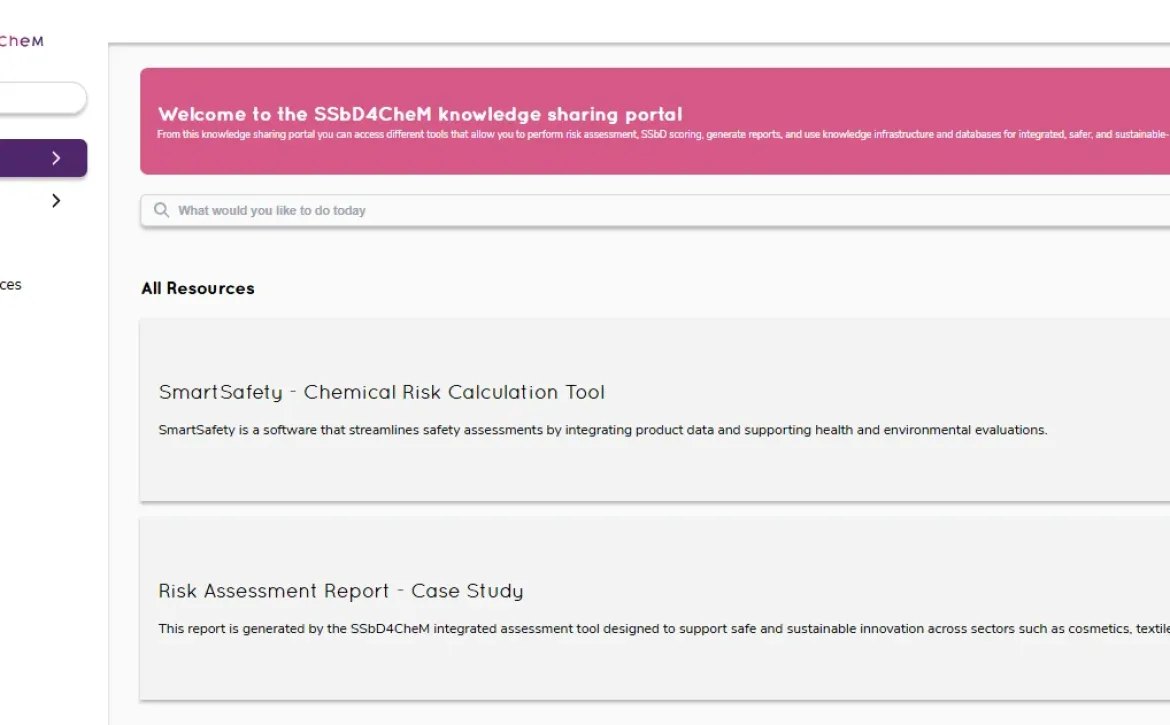
Through the platform, users can access different tools that allow them to perform risk assessment, SSbD scoring, generate reports, and use knowledge infrastructure and databases for integrated, safer, and sustainable-by-design workflows. By the beginning of January 2026, the platform contains following resources:

  • Risk Assessment Report – Case Study: This report is generated by the SSbD4CheM integrated assessment tool designed to support safe and sustainable innovation across sectors such as cosmetics, textiles, and automotive.
  • SmartSafety – Chemical Risk Calculation Tool: Software that streamlines safety assessments by integrating product data and supporting health and environmental evaluations.
  • ASPA-assist: Web-based graphical interface which guides users through the steps and decisions involved in applying the SSbD process.
  • ToxTemp: Web-based tool and database designed to document methods by supporting various readiness levels to ensure method evaluation and transparency.
  • ACCORDs KI: Platform for accessing and submitting research protocols, experimental data, and images, offering standardised upload templates and a materials characterisation toolbox.
  • SDS collector/extractor: Tool that allows users to search, download, and extract structured data from SDS using CAS numbers or IUPAC names, exporting the information in CSV format.
  • PubMed ChemInsight: To accelerate literature discovery on chemicals and biological targets with smart search, synonym expansion, and automated result delivery.
  • PubChemPal: Interactive, user-friendly application that enables scientists, researchers, and regulatory professionals to retrieve, clean, and explore structured PubChem compound data using CAS numbers or PubChem CIDs.
  • ECHA database and notebooks: Provides access to chemical safety data and organized documentation (e.g. Chemical similarity search on RDT studies from REACH database, Repeated dose toxicity studies from reach database, EdelweissData dataset for CLP classifications, EdelweissData dataset for ecotoxicological endpoints)
  • Protocols area – guidance and database: Database of in silico and in vitro protocols used throughout the project, providing standardized methods and guidance.
  • Data area – guidance and access: Guidance page for information on data management

SSbD4CheM Protocol Database with uploaded protocols

The SSbD4CheM Knowledge Sharing Platform is designed as a collaborative space. By connecting tools, knowledge, and stakeholders, it supports dialogue and exchange between scientists, innovators, regulators, and sustainability experts working toward the same goal: chemicals and materials that are safe and sustainable by design. It is a practical enabler for embedding SSbD thinking into chemical and material innovation, helping turn policy ambitions into actionable, science-based practice.


Explore now the SSbD4CheM Knowledge Sharing Platform here.

Read More
QSAR2025

SSbD4CheM @ QSAR 2025

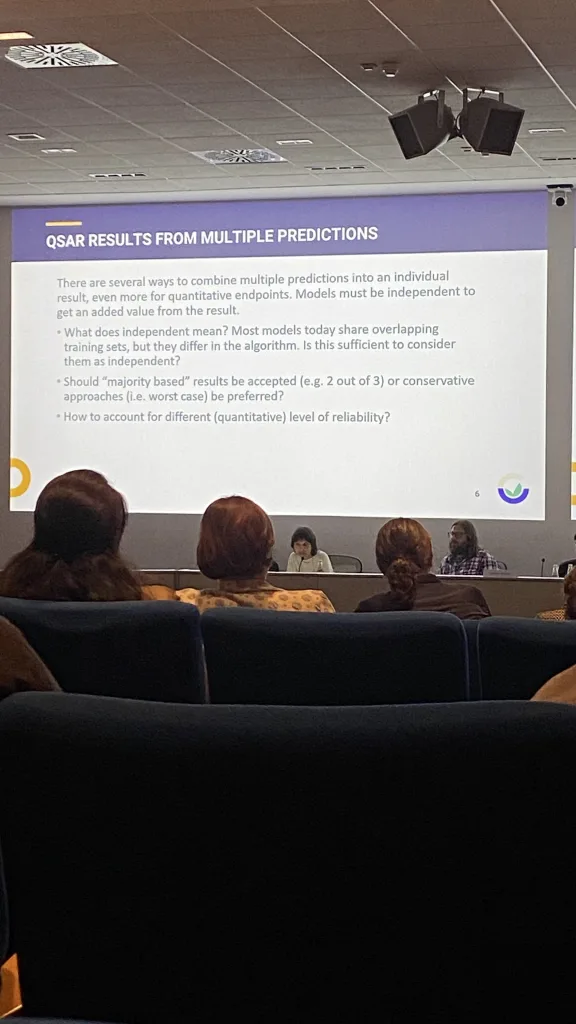
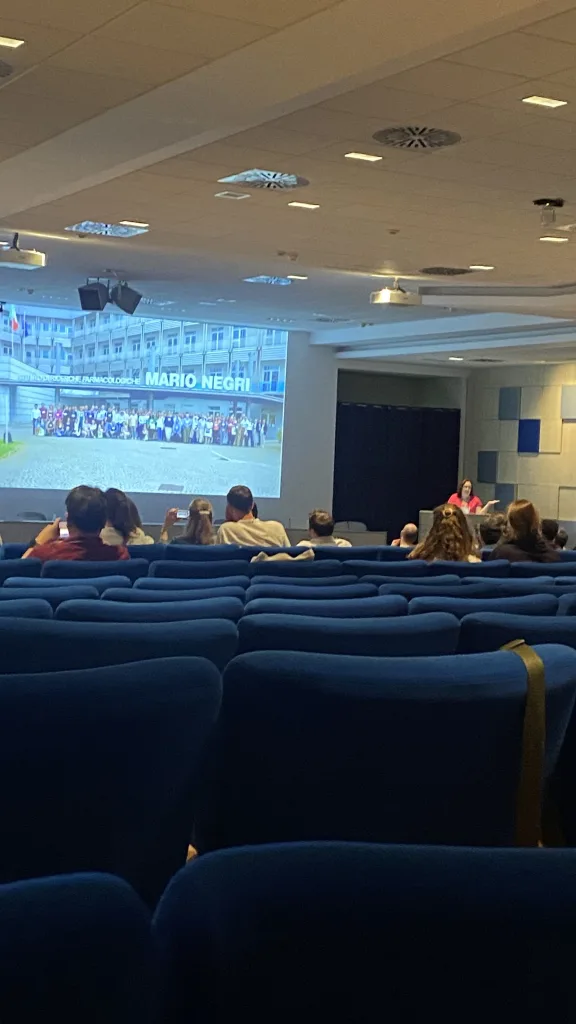
The SSbD4CheM project was featured at the 21st International Workshop on QSAR in Environmental and Health Sciences (QSAR 2025), held from 3 to 6 June 2025 in Milan, Italy. Hosted at the Mario Negri Institute, the event brought together around 100 participants from research, industry, and regulatory organisations.

QSAR 2025 served as a key platform for discussing the latest advances in in silico toxicology, with a strong focus on QSAR modelling, read-across approaches, and New Approach Methodologies (NAMs). The workshop highlighted how these computational tools support chemical safety assessment within frameworks like Safe and Sustainable by Design (SSbD) and regulatory initiatives such as REACH and CLP.

The programme included keynote contributions from prominent institutions such as OECD, ECHA, and EFSA, alongside hands-on sessions, and poster discussions that fostered knowledge exchange and collaboration among participants.

Cristina Sánchez Ferri, from SSbD4CheM partner ITENE, contributed to the conference through a poster presentation entitled “Automated hazard assessment pipeline for SSbD: Integrating bibliographic and QSAR predicted data for safety assessment”, presented in the session “(Q)SARs for screening, prioritization and data gap filling”. The work presented an automated Python-based pipeline designed to streamline hazard assessment in line with the SSbD framework. By integrating existing bibliographic data with QSAR predictions, the tool enables efficient data gap filling, prioritisation of substances for testing, and improved data consistency and traceability. A novel Consistency Index was introduced to assess the reliability of the aggregated data, enhancing transparency and robustness in decision-making processes.

The participation of SSbD4CheM in QSAR 2025 was highly relevant, as the methodologies and workflows developed within the project are closely aligned with the conference themes, particularly in the application of computational tools for regulatory and sustainability purposes.

The workshop provided valuable insights into current trends, challenges, and best practices in QSAR modelling and its regulatory applications. It also offered opportunities for networking and future collaboration, reinforcing the importance of harmonisation, transparency, and validation in computational toxicology.

Through its presence at QSAR 2025, the SSbD4CheM project continues to strengthen its contribution to the development and implementation of innovative in silico approaches supporting the transition towards safer and more sustainable chemicals.

Read More