The Young Women’s Conference (YWC) Luxembourg 2026 brought together more than 500 young women, along with their teachers and school classes, at the Belval campus of the University of Luxembourg on 19 March 2026. By combining scientific exchange, career guidance and hands-on experiences, the event aimed to inspire the next generation to explore careers in science, technology, engineering and mathematics (STEM), highlighting the diversity of opportunities in research and innovation.
YWC Luxembourg 2026 was supported by the Luxembourg National Research Fund and coordinated by LIST.
Inspired by the successful Young Women’s Conference model established by Princeton University’s Science Education Department, the event featured keynote speeches, interactive exhibition booths, career panels and a “Living Library” offering opportunities to engage directly with researchers. The 2026 edition welcomed 2 keynotes, 40 panel speakers, 4 young moderators, 40 books in the living library, and more than 20 exhibitors representing academia (Luxembourg University), research institutions, government and industry.
As part of the conference, Antje Biesemeier, LIST, was invited to participate as a panel speaker. Together with three other researchers, she discussed her school experiences and the motivations that led her to pursue a career in MINT research. The conversations explored personal ambitions, hopes, fears and the everyday challenges of life and work, offering the young participants an authentic insight into the realities of scientific careers.
The conference provided an opportunity to encourage young women to discover their interests, build confidence and see themselves as future scientists and innovators.
The Luxembourg Institute of Science and Technology (LIST), which coordinated the organisation of event, presented its research through several working groups showcasing activities in space and materials science, characterisation and environmental health.
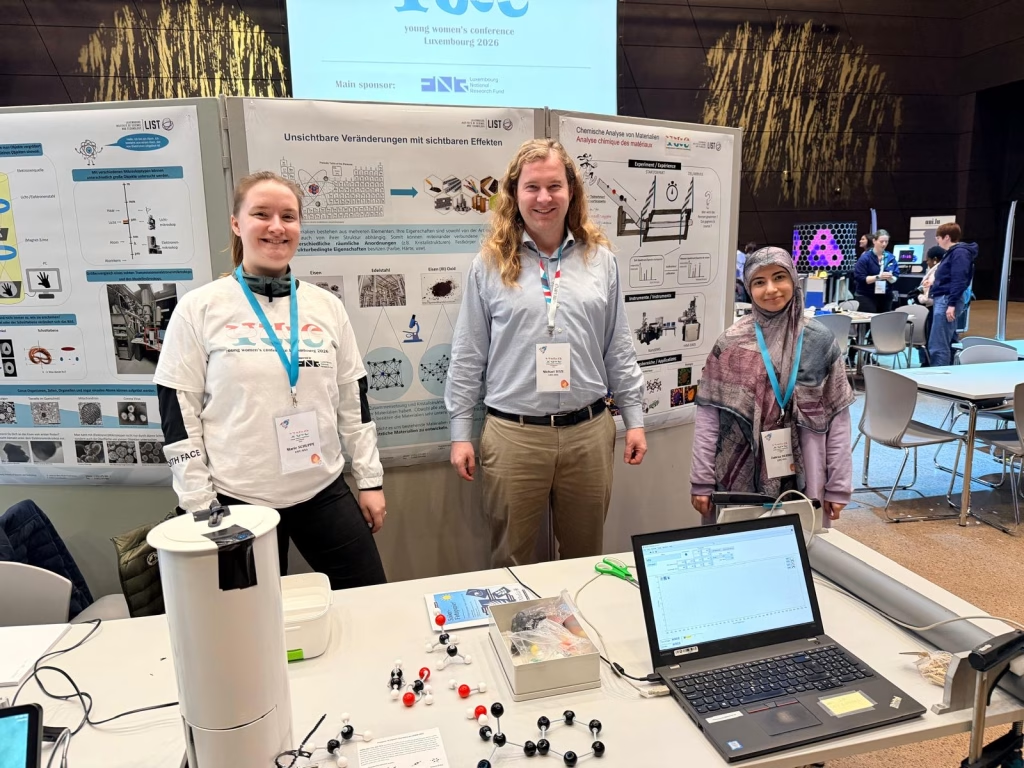
LIST’s Advanced Instrumentation for Nanoanalytics group demonstrated in a booth how microscopy and secondary ion mass spectrometry can be used to investigate the shape, size and chemical composition of materials. These analytical techniques generate valuable data for understanding how materials interact with biological and environmental systems and for investigating their potential toxicity.
Such insights are particularly relevant to SSbD4CheM, which promotes the development of safer and more sustainable chemicals and materials. By supporting the assessment of material properties, potential exposure and safety, advanced analytical methods contribute to the evidence needed to design innovative materials with reduced risks to human health and the environment.
The next edition of the Young Women’s Conference Luxembourg is scheduled for 18 March 2027, continuing its mission to inspire young women and foster a more inclusive and innovative scientific community.