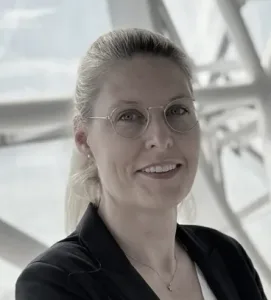
Yvonne Kohl is a senior scientist at the Bioprocessing & Bioanalytics department of the Fraunhofer Institute for Biomedical Engineering IBMT (Germany). Within SSbD4CheM, she is leading the work package dealing with models for human health and environmental safety assessment.
Tell us a bit about yourself. What is your area of expertise?
Yvonne Kohl: My professional expertise is in toxicology, with a strong focus on in vitro safety assessment. Over the past years, my research focused on establishing human-relevant in vitro models, often referred to as New Approach Methods (NAMs), with the goal of enabling their regulatory use. As a Senior Scientist and Scientific Specialist for Toxicology at the Fraunhofer IBMT my main areas of work include human toxicology, hazard assessment of chemicals and nanomaterials, innovative preclinical in vitro models, biohybrid systems, biological barriers and organ-on-chip systems.
How does your specific work package “Innovative models for human health and environmental safety assessment” contribute to the project?
YK: WP4 is really the engine of the project when it comes to innovative safety testing. Our role is to develop and deliver the core model systems and data that are needed for a modern, reliable safety assessment of nanomaterials and chemicals. Concretely, we develop and refine advanced in vitro, ex vivo and zebrafish embryo models that reflect key human and environmental exposure routes, such as skin, lung, gut and the aquatic environment. We then optimise these methods into robust, efficient screening tools that are fully aligned with the 3R principles—replacement, reduction and refinement of animal testing. At the same time, we are building a comprehensive data library on hazardous properties to address critical knowledge gaps. To ensure that our methods are truly fit for purpose, we run inter-laboratory comparisons and pre-validation studies up to TRL 6, demonstrating reproducibility, applicability and robustness and moving the methods closer to practical application in regulation and industry. Through all of this, WP4 provides the practical tools and evidence base that enable safer-by-design decision-making and support the regulatory acceptance of alternative test methods..
What is the most exciting thing about the activities in your work package?
YK: What excites me most about our work package is that we’re not just developing isolated test methods, but building an integrated, human-relevant model system. This allows us to realistically mimic key exposure routes—such as skin, lung, and gut—and to capture low-dose, chronic effects of nanomaterials and chemicals. By combining advanced in vitro and alternative models with real-life exposure scenarios, and then validating them through inter-laboratory comparisons, we’re really closing the gap between exploratory research and regulatory or industrial application. This gives our work a very tangible impact: it can directly contribute to reducing animal testing in line with the 3R principles, support safe-by-design innovation, and provide practical tools that industry and regulators can actually implement in their decision-making.

- Yvonne Kohl
Senior Scientist at Fraunhofer Institute for Biomedical Engineering (IBMT)“We’re building integrated, human-relevant model systems that mimic key exposure routes like skin, lung and gut, rather than isolated test methods. By combining advanced in vitro approaches with real-life scenarios and validating them across laboratories, we close the gap to application—reducing animal testing and enabling practical, safe-by-design solutions for industry and regulators.”
From your point of view, who can benefit the most from the project?
YK: From my perspective, several groups benefit significantly, but industry and regulators are at the core. Chemical and material manufacturers, including SMEs, can design “future-proof” products by integrating safety and sustainability from the start, avoiding costly redesigns and regulatory hurdles. Formulators, downstream users and brand owners gain a structured way to choose safer ingredients, document decisions and de‑risk their supply chains. Regulators and policymakers benefit from a harmonised SSbD framework and shared language, while investors, researchers and, ultimately, society and the environment gain from safer, more sustainable innovations and products.