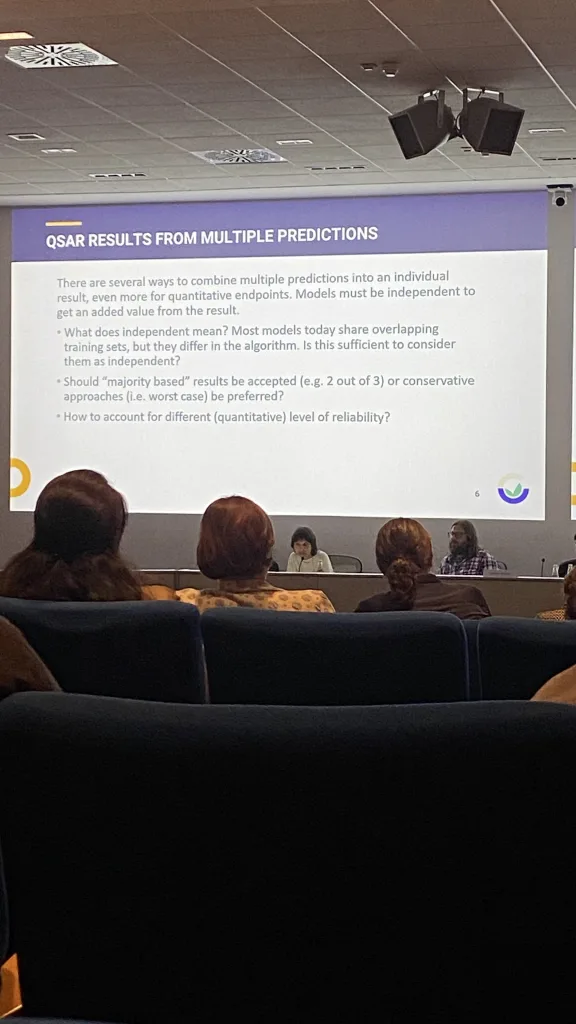
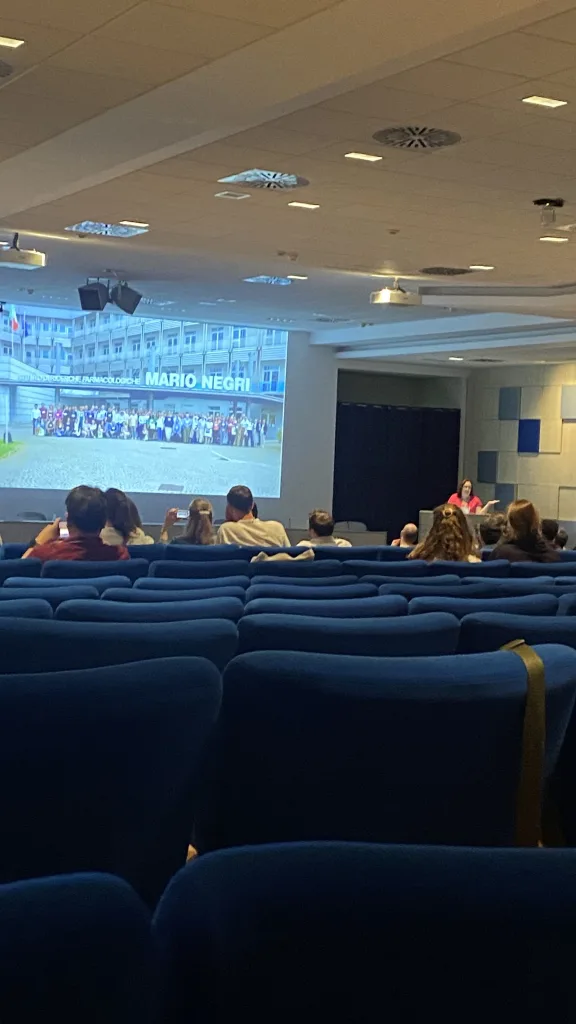
The SSbD4CheM project was featured at the 21st International Workshop on QSAR in Environmental and Health Sciences (QSAR 2025), held from 3 to 6 June 2025 in Milan, Italy. Hosted at the Mario Negri Institute, the event brought together around 100 participants from research, industry, and regulatory organisations.
QSAR 2025 served as a key platform for discussing the latest advances in in silico toxicology, with a strong focus on QSAR modelling, read-across approaches, and New Approach Methodologies (NAMs). The workshop highlighted how these computational tools support chemical safety assessment within frameworks like Safe and Sustainable by Design (SSbD) and regulatory initiatives such as REACH and CLP.
The programme included keynote contributions from prominent institutions such as OECD, ECHA, and EFSA, alongside hands-on sessions, and poster discussions that fostered knowledge exchange and collaboration among participants.
Cristina Sánchez Ferri, from SSbD4CheM partner ITENE, contributed to the conference through a poster presentation entitled “Automated hazard assessment pipeline for SSbD: Integrating bibliographic and QSAR predicted data for safety assessment”, presented in the session “(Q)SARs for screening, prioritization and data gap filling”. The work presented an automated Python-based pipeline designed to streamline hazard assessment in line with the SSbD framework. By integrating existing bibliographic data with QSAR predictions, the tool enables efficient data gap filling, prioritisation of substances for testing, and improved data consistency and traceability. A novel Consistency Index was introduced to assess the reliability of the aggregated data, enhancing transparency and robustness in decision-making processes.
The participation of SSbD4CheM in QSAR 2025 was highly relevant, as the methodologies and workflows developed within the project are closely aligned with the conference themes, particularly in the application of computational tools for regulatory and sustainability purposes.
The workshop provided valuable insights into current trends, challenges, and best practices in QSAR modelling and its regulatory applications. It also offered opportunities for networking and future collaboration, reinforcing the importance of harmonisation, transparency, and validation in computational toxicology.
Through its presence at QSAR 2025, the SSbD4CheM project continues to strengthen its contribution to the development and implementation of innovative in silico approaches supporting the transition towards safer and more sustainable chemicals.