The SETAC Europe 36th Annual Meeting took place from 17–21 May 2026 in Maastricht, the Netherlands, bringing together around 2,500 participants from academia, industry, governmental institutions, and regulatory bodies interested in the programme, which included keynote lectures, oral and poster presentations, workshops, and networking events. This year, the event’s theme was ‘Embrace the outlier: in science, regulations, and networks’, bringing together diverse perspectives to advance environmental sciences and their adoption in policy making, and serving as a major platform for discussing the latest scientific and regulatory developments in environmental toxicology, environmental chemistry, sustainability, life cycle assessment (LCA), risk assessment, Safe and Sustainable by Design (SSbD), as well as including industrial ecology, material science, pharmaceutical sciences, governance studies, agricultural studies, etc.
SSbD4CheM partners from VITO (Xiaoyu Zhang and Wouter Gebbink), Leiden University (Thomas Arblaster, Nils Thonemann, and Jeroen Guinée) and BNN (Katharina Lang-Hogrefe) actively contributed to the conference by presenting research related to PFAS replacement strategies, the safe implementation of sustainable materials in industrial applications, as well as LCA in the automotive case study, and best practices in scientific communication.
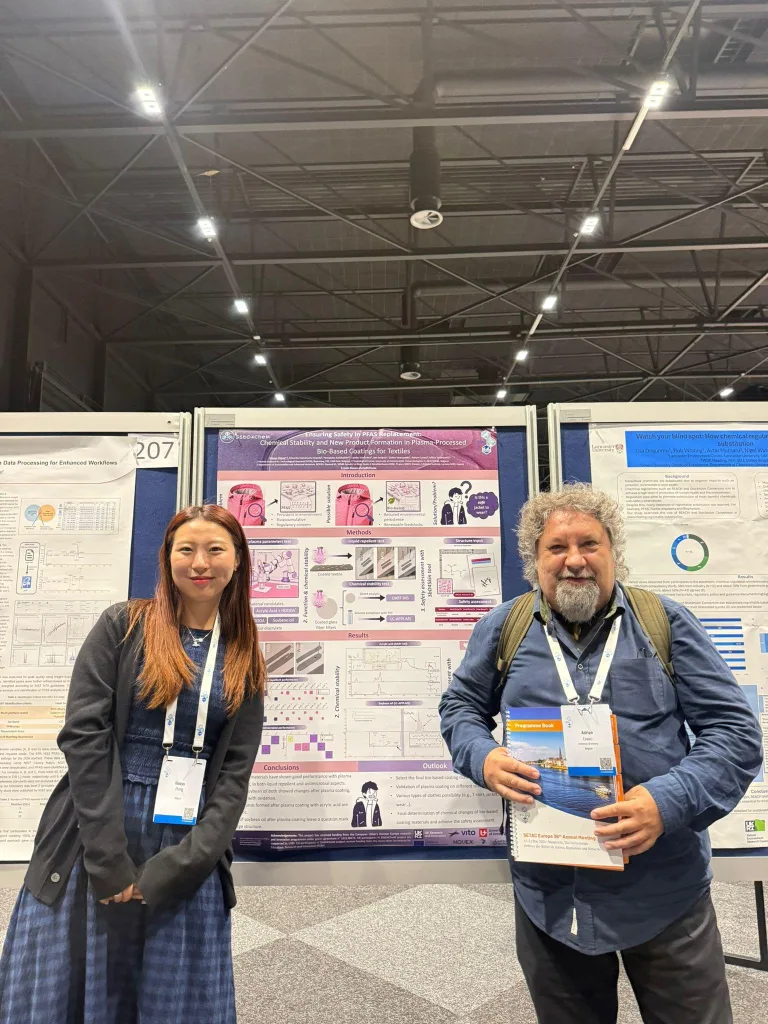
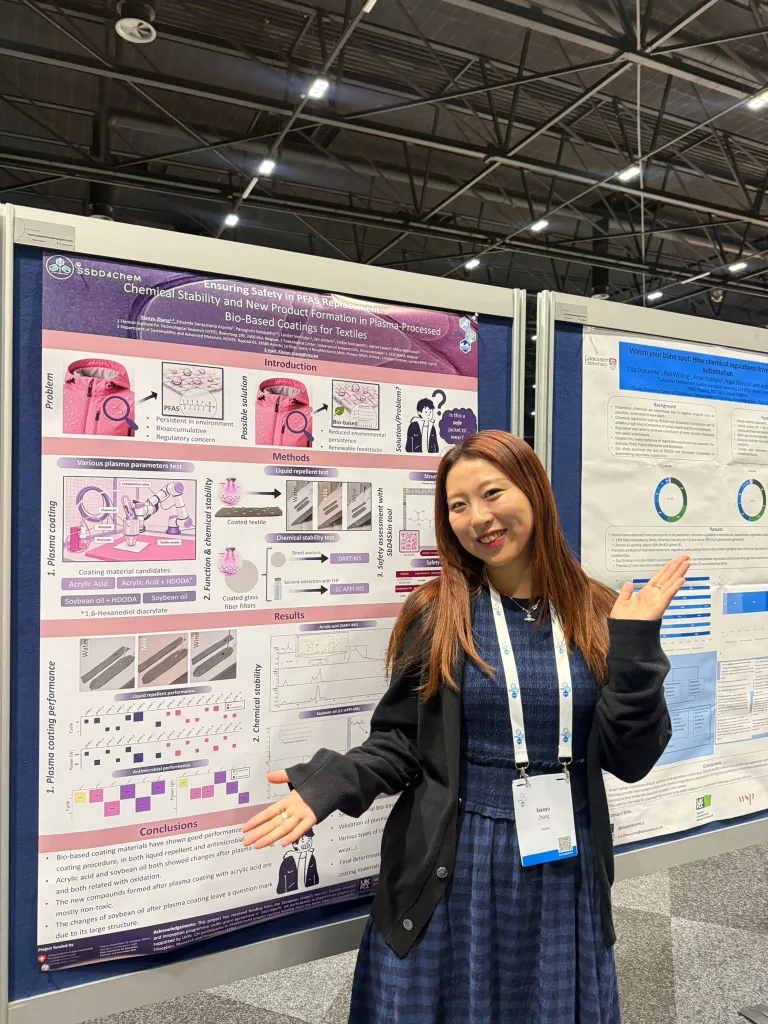
Xiaoyu Zhang (VITO) presented a poster entitled “Ensuring Safety in PFAS Replacement: Chemical Stability and New Product Formation in Plasma-Processed Bio-Based Coatings for Textiles”, on 19th May. The research focused on evaluating bio-based alternatives to PFAS-based textile coatings and assessing their chemical stability and safety following plasma processing. The study investigated acrylic acid and soybean oil-based coatings as potential PFAS-free solutions for textile applications. Using advanced analytical methods, including DART-MS and LC-APPI-MS, the work evaluated liquid repellency, antimicrobial performance, and the formation of new compounds after plasma treatment. The results demonstrated that bio-based coatings can offer promising functional performance while potentially reducing environmental persistence compared to conventional PFAS-containing materials. The work also included a preliminary safety assessment using the SbD4Skin tool, supporting the development of safer and more sustainable textile materials.
Wouter Gebbink (VITO) contributed with a presentation entitled “Occupational and Consumer Exposure to VOCs during the Production and Use Phase of Renewable Wood Plastic Composites for Car Interior Trims”, presented during the session Innovative Strategies in Implementing Safe and Sustainable by Design (SSbD) Approaches, on 21st May. The study evaluated worker and consumer exposure to volatile organic compounds (VOCs) during the production and use of renewable wood plastic composites for automotive interior panels. Key conclusions included: (i) Incorporating wood-based fillers in car interior panels can eliminate or reduce risks for workers during production and for consumers exposed to TVOC and FOG emissions inside vehicles. (ii) Weathered materials showed significantly lower TVOC/FOG emissions compared to pristine materials, resulting in lower in-car air concentrations. (iii) Although all estimated exposure levels remained below safe thresholds, children under 11 years of age experienced equal or higher exposure levels compared to adults. DOI: 10.5281/zenodo.20392915.
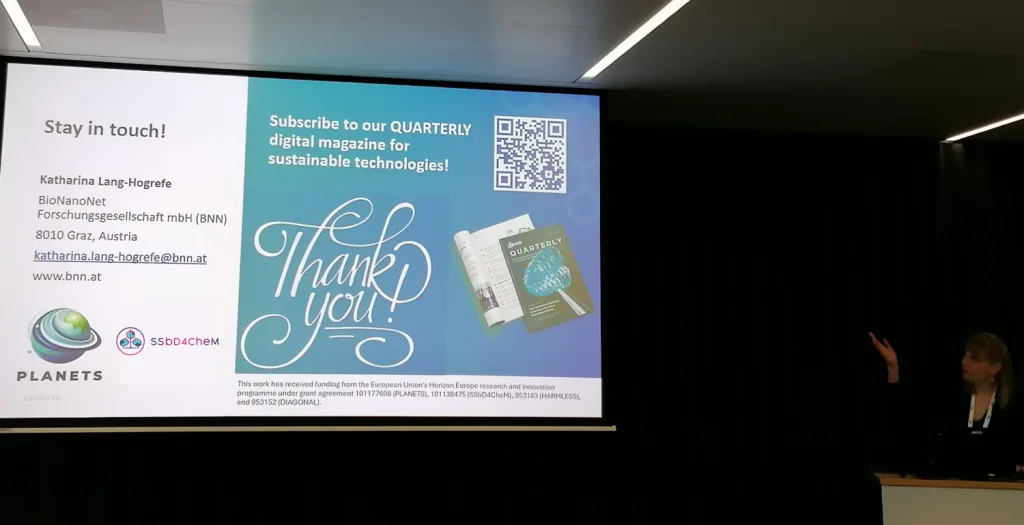
Katharina Lang-Hogrefe (BNN) gave an oral presentation on scientific communication, entitled “Clear, Concise, and Complete: Finding the Sweet Spot for Detail and Simplification in Science Communication“, on 18th May in the Session “6.10 – Translating Complexity – The Role Science Communication Plays in Generating Lasting Societal Impact“. DOI: 10.5281/zenodo.20345940.
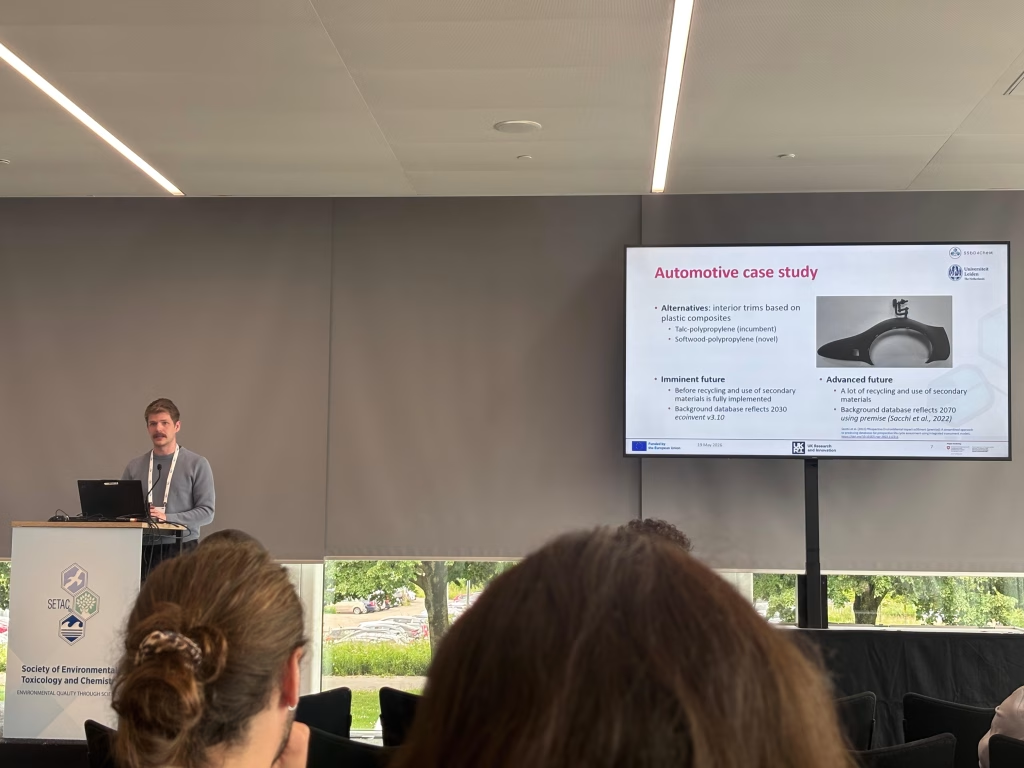
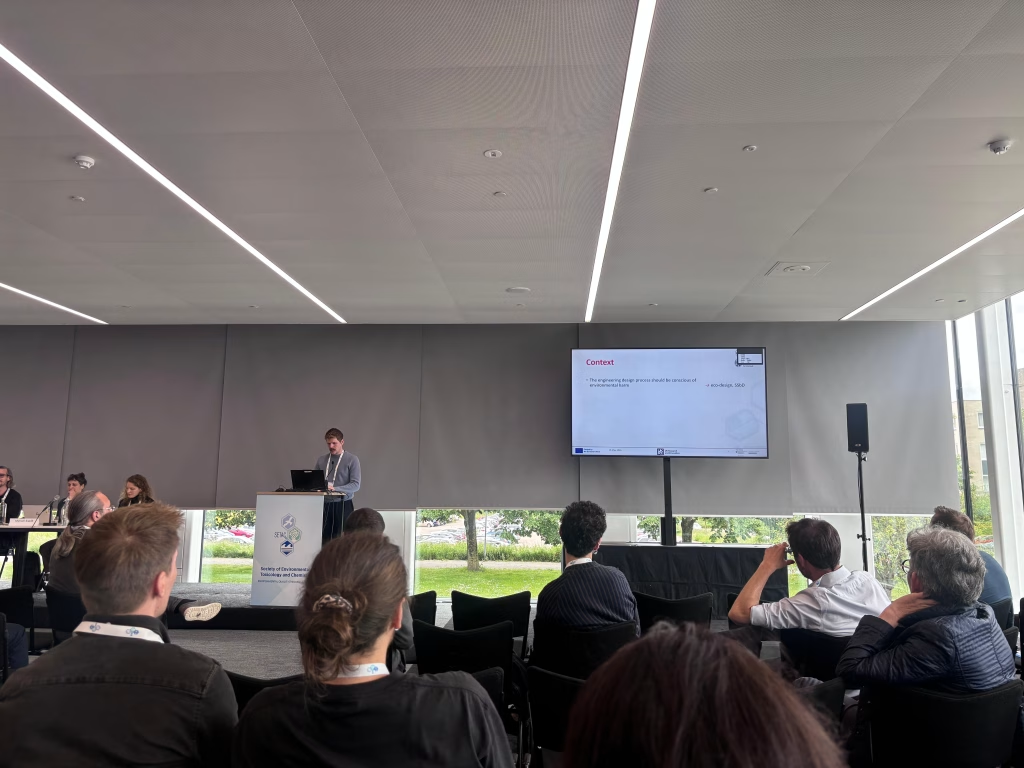
Thomas Arblaster (Leiden University) gave an oral presentation on 19th May, entitled “Is Time-Explicit Life-Cycle Assessment Useful? A Vehicle Eco-design Case Study“, in session 5.02 ‘Advancing Methods for Prospective Life Cycle Assessment to Support Radical Approaches to Sustainable Research and Innovation’, which was part of track 5 ‘Life Cycle Assessment and Foot-Printing’. In his presentation, Thomas outlined how the consideration of time affects the assessment of a system in the context of eco-design – such as occurs in SSbD. This work was conducted as part of WP6 in SSbD4CheM and forms an important contribution to the development of guidance for a robust ex-ante assessment to inform environmental sustainability. In the presentation, four temporal perspectives were explained, which differ in how they consider the system’s relationship with time. The consideration of imagined futures (prospective LCA) which may change over time (time-explicit LCA) is a rapidly expanding niche in the LCA community. This study critically addresses some of the recent advancements and proposes new classifications with which to describe how time is considered in an LCA study. DOI: 10.5281/zenodo.20395341.
The participation in SETAC Europe 2026 provided an important opportunity for SSbD4CheM partners to disseminate research outcomes, engage with experts in environmental safety, analytical chemistry, operationalisation of ex-ante LCA for (environmental) sustainability assessment in SSbD, and strengthen collaboration within the sustainability and toxicology communities.
The posters and oral presentations generated valuable scientific discussions around SSbD implementation, PFAS alternatives, environmental exposure assessment, sustainable materials development, LCA, and scientific communication. The event also contributed to increasing the visibility of the project and fostering future networking and collaboration opportunities.